AI Search-Optimized Content Strategy Explained
October 13, 2026
Quick Answer: AI-optimized content marketing means creating content that AI search tools can find, understand, and reference, while making it useful and engaging for people. For enterprise teams, that involves clear explanations, credible sources, and content that answers buyers’ questions. Video can help bring those answers to life and give buyers more confidence as they evaluate your brand.
- What AI-optimized content marketing means
- How AI search changes the buyer journey
- How AI optimization relates to traditional SEO
- How to Build an AI-Optimized Content Marketing Strategy
- Measure visibility alongside traffic
- Keep the approach consistent across teams
- A checklist for enterprise marketing teams
- FAQs
Imagine your VP of Sales sends you a screenshot. A prospect asked an AI assistant to recommend vendors in your category. Your biggest competitor made the list. Your brand didn’t.
It’s a simple example, but it raises a question many marketing teams are grappling with: how do we ensure buyers find us when they research using AI?
Buyers still want to understand their options, compare vendors, and feel confident about a decision. AI gives them another way to do that, sometimes before they visit a company’s website. The content you’ve spent years building needs to work in that setting, too.
The good news is that much of this starts with familiar content practices. Explain what you do clearly. Answer questions your buyers actually ask. Back up your claims. This guide looks at how those practices apply to AI search, what to measure, and where video fits into the strategy.
What AI-optimized content marketing means
AI-optimized content marketing is the practice of planning, creating, and distributing content so AI tools can find it and use it in their answers. Those tools include Google’s AI Overviews and assistants like ChatGPT, Claude, and Gemini.
You still need to write for people. But your content may also become part of an AI-generated summary, comparison, or recommendation before someone reaches your site.
That adds another question to your content strategy. Alongside “Will this page rank?” you need to ask, “When a buyer asks about our category, does our brand appear, and does the answer describe us accurately?”
How AI search changes the buyer journey
Think about an IT director evaluating software for a global manufacturer. Before booking a demo, she might ask an AI assistant to compare platforms, explain pricing models, and identify integration concerns. Those answers could help shape her shortlist.
Research points to growing use of these tools. McKinsey reports that half of consumers intentionally seek out AI-powered search engines. Forrester reports that 94 percent of business buyers use AI during the buying process.
For marketing teams, that means a buyer’s first impression may come from an AI answer. If your content doesn’t clearly explain what you offer and who it’s for, buyers may get an incomplete picture of your business. Reviewing those answers can help you see where your messaging needs work.
How AI optimization relates to traditional SEO
This is important to keep in mind: traditional SEO remains part of the foundation. Many AI tools draw on web content that search engines can discover and index. Clear writing, useful information, and a technically accessible website still matter.
AI optimization adds another focus: how your content contributes to an answer, including whether your brand gets mentioned and how it’s described.
| Area | Traditional SEO | AI-optimized content marketing |
| Main goal | Improve visibility in search results | Improve visibility and accuracy in AI answers |
| Content focus | Relevant pages that satisfy search intent | Clear answers and specific information AI tools can reference |
| Useful formats | Web pages, articles, video, and other indexed content | Those same formats, with accessible text, transcripts, and supporting sources |
| Measures of success | Rankings, organic traffic, and conversions | Brand mentions, citations, accuracy, and influence on demand and pipeline |
Pew Research Center found that Google users clicked a traditional search result in 8 percent of visits when an AI summary appeared, compared with 15 percent when one didn’t. That makes it useful to look beyond clicks when assessing how people discover your brand.
How to Build an AI-Optimized Content Marketing Strategy
Start with a clear explanation of what you do
At Digital Brew, we’ve spent over a decade helping brands explain complex ideas. That work is just as relevant when content needs to make sense in an AI answer.
Compare “the next-generation platform for transformative outcomes” with a sentence that explains what the product does and who uses it. The second gives readers something concrete to understand and AI tools something specific to reference.
Try this with a key page on your website: could someone outside your industry explain what you do, who you help, and why it matters after reading it?
If the answer is unclear, start there. Put the main explanation in the first few sentences, then add examples and details. Buyers shouldn’t have to piece together your offer from several pages.
Build useful content around your buyers’ questions
A single article can answer one question. A connected group of resources can help buyers understand a topic in more depth and give AI tools more relevant information to draw on.
For example, a cybersecurity company focused on zero trust in healthcare might publish a detailed guide, an explainer video, a customer story, and answers to common implementation questions. Each piece serves a different need, while using consistent definitions and linking to related resources.
Your website is only part of the picture. Industry publications, review sites, YouTube, and community discussions can also contribute to how buyers and AI tools understand your brand. Content, PR, and partner marketing teams should work from the same messaging so people get a consistent explanation wherever they find you.
Make your content easy to follow
Clear structure helps readers find what they need. It also makes individual answers easier for AI tools to identify and reference.
- Lead with the answer. Start key pages with a concise explanation, then add detail.
- Use headings that reflect buyers’ questions. Choose wording your audience would naturally use.
- Explain important terms. Give unfamiliar concepts a clear definition and a practical example.
- Include transcripts and captions. Make the information in your videos available as text.
- Use relevant schema markup. Structured data can help search systems understand the content on a page.
With that in mind, these practices work best when the content itself is useful. A well-formatted page still needs accurate information and something worthwhile to say.
Where video fits into an AI content strategy
An AI summary can help a buyer narrow down their options. A product demo, expert interview, or customer story can help them evaluate those options more closely.
Think back to the IT director. Once she has a shortlist, she may want to see how a product works, hear someone explain an integration, or learn how another company handled a similar rollout. Video gives her more to work with before she brings a recommendation to her team.
HubSpot reports that 21 percent of marketers identify short-form video as the content format with the highest ROI. [4] Pew’s research also found YouTube among the sources most frequently linked in Google AI summaries. Those findings support considering video both as a way to reach people and as a resource they can use during research.
To make each video easier to discover and understand, add a descriptive title, a useful summary, chapters where appropriate, and a transcript. Embed it on a relevant page so viewers can find supporting information alongside it.
Choose the format around the question you need to answer. A short explainer might introduce an idea, while a detailed demo helps a buyer understand how it works in practice.
Bring your team’s experience into the content
Your team has knowledge that a generic article can’t offer: lessons from a difficult rollout, answers to recurring customer questions, or a practical explanation of an integration.
Much of that knowledge stays in sales calls and internal conversations. A simple interview process can help you capture it. Record a short conversation with a subject matter expert, then use the most useful answers in a video, article, LinkedIn post, or FAQ.
Keep the details that make the answer specific. What went wrong? Or what did the team learn? What would they recommend to someone facing the same problem?
Those details give buyers a reason to trust the content and give AI tools original information to reference. Video also lets buyers hear directly from the people behind the advice.
Measure visibility alongside traffic
Organic traffic tells you how many people reach your site. It doesn’t tell you how often your brand appears in AI answers or whether those answers get the details right.
McKinsey reports that only 16 percent of brands systematically track their AI search performance. [1] A regular review can help your team understand where you appear today and what changes over time.
- Start with a manageable set of questions your buyers ask, and track:
- Brand mentions and citations. How often do AI tools include your brand, and which sources do they reference?
- Accuracy and context. Do the answers explain your offer correctly? Do they associate you with the right use cases?
- Branded search and direct traffic. Watch for changes, while recognizing that several factors can affect these metrics.
- Content engagement. Review video completion rates, time on page, and what visitors do next.
- Pipeline influence. Ask prospects how they found you and whether AI tools played a role in their research.
Read these measures together. They can help you see whether improved visibility is bringing in relevant buyers and supporting sales conversations.
Keep the approach consistent across teams
Enterprise teams often have plenty of content. The harder part is keeping it connected when product marketing, demand generation, regional teams, and customer success all publish on different schedules.
Basically, start with shared messaging that defines your offer, key terms, and supporting evidence. Make it easy for every team to find and use.
Then build a regular review into your process. Each quarter, check your priority content, review how AI tools describe your brand, and identify questions you haven’t answered well.
You can also get more use out of the content you already create. An explainer video might support a landing page, a sales presentation, and an onboarding sequence. Short sections can become social clips when they answer a clear question on their own.
A consistent publishing rhythm gives your team a practical way to keep information current and address new questions as they come up.
A checklist for enterprise marketing teams
Use this checklist to review your content and decide where to focus first.
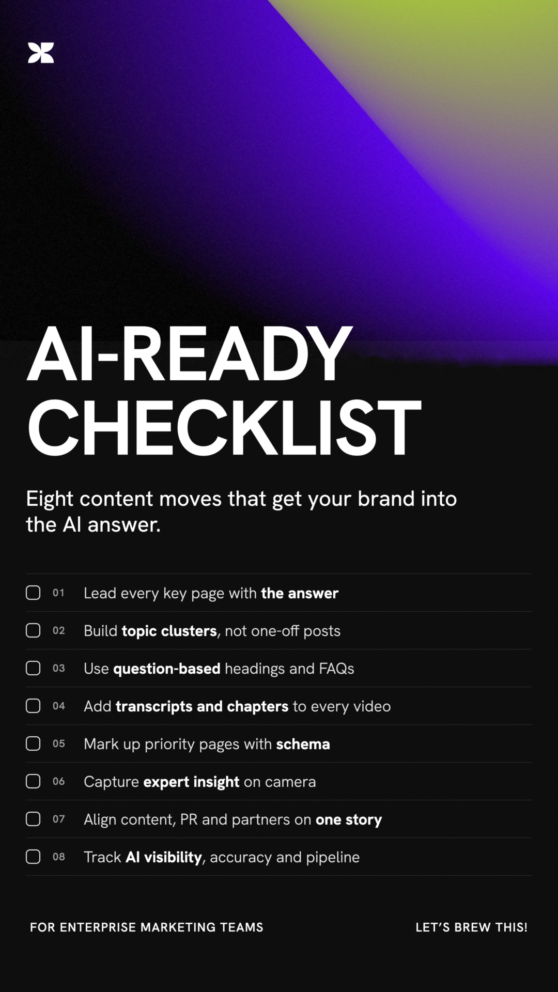
You don’t have to tackle everything at once. Start with the questions that matter most to your buyers, review how well your content answers them, and build from there. Clear, useful content gives your brand a better chance of showing up in their research and helps people understand why you could be the right fit.
Want help making your content clearer and easier to find? Our Brew Crew can help you turn complex ideas into useful stories and videos that support your buyers’ research.
FAQs
The terms overlap. Generative engine optimization (GEO) and answer engine optimization (AEO) describe efforts to improve visibility in generated answers. AI-optimized content marketing applies that goal to your content strategy, including the questions you answer, the formats you use, and how the content supports buyers.
No. Keep investing in useful content and a website that search engines can access. Add AI visibility to your existing reviews so you can assess how your brand appears in both search results and generated answers.
AI answers can reference sources such as YouTube, and transcripts make the information in a video available as text. Video also helps buyers evaluate what they’ve learned by showing a product in use or letting them hear from an expert or customer.
Timing depends on your category, existing content, and the tools you’re monitoring. Review results regularly as you update pages and publish, and look for patterns over time. An individual mention doesn’t tell you whether your visibility has improved consistently.