How Interactive 3D Visualization Improves Hardware UX
July 21, 2026
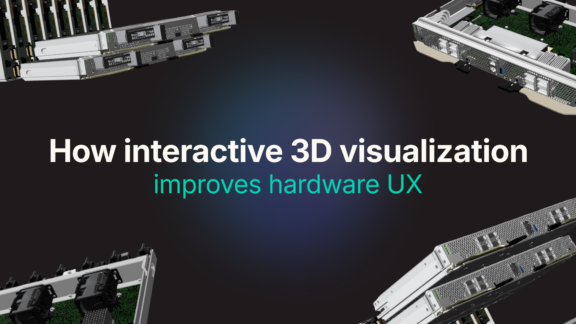
Quick Answer: Interactive 3D product visualization transforms the way B2B buyers understand complex hardware by letting them explore every angle, feature, and function before a single sales call happens. Instead of relying on static product images that leave buyers guessing, 3D visualization turns complexity into clarity and gives your audience the confidence to move forward. If you sell hardware with technical depth, this is a tool that earns its place in your marketing stack.
- Why Static Product Images Fall Short for Hardware Buyers
- What 3D Product Visualization Actually Means
- How Interactive Product Views Accelerate Buyer Understanding
- The Customer Engagement Difference: Static vs. Interactive
- 3D Product Visualization as a Hardware Visualization Strategy
- How 3D Visualization Supports Sales Enablement
- Reducing Purchase Hesitation Through Better Product Understanding
- 3D Product Visualization and Its Impact on Product Understanding Across the Funnel
- Integrating 3D Visualization Into Your Existing Content Strategy
- What to Look for When Building a 3D Visualization Program
- Wrap Up: What Marketing Leaders Should Take Away
- FAQs
Imagine a procurement lead at an enterprise technology company evaluating three competing hardware platforms. She opens your product page and sees a well-lit photograph of the device. It looks professional. It looks clean. However, she still cannot tell how the ports are configured, whether the form factor fits her rack setup, or how the interface panel is organized. She closes the tab and keeps looking.
That is not a creative failure. It is a distribution failure of understanding.
B2B hardware buyers face a specific challenge: the products they evaluate are intricate, the decisions are expensive, and the stakes for a wrong purchase are high. Static product images, however polished, simply cannot carry that weight. They compress a three-dimensional object into two dimensions and strip out the context that makes technical decisions possible.
In this article, we will walk through exactly how interactive 3D product visualization solves this problem, why it outperforms static product images at every stage of the buyer journey, and what it means for customer engagement, hardware visualization, and ultimately your pipeline.
Why Static Product Images Fall Short for Hardware Buyers
Static product images have served marketing teams well for decades, and in many categories they still do the job. For consumer goods, a clean photograph communicates value quickly. However, for B2B hardware, the cognitive demand on the buyer is fundamentally different.
A network switch, a medical imaging device, an industrial IoT sensor: these are not products that communicate their value in a single angle. Buyers need to understand configuration options, physical dimensions, interface layouts, and how the product integrates into an existing environment. Static product images force the buyer to fill in those gaps mentally, and most of the time, they cannot.
Furthermore, the sales cycle for enterprise hardware is rarely a solo journey. Decisions move through technical evaluators, finance teams, and executive stakeholders. Each person has different questions. A static image answers none of them independently. As a result, every unanswered question becomes friction that slows the deal.
What 3D Product Visualization Actually Means
Before going further, it is worth clarifying what we mean by 3D product visualization in a B2B marketing context.
At its core, 3D product visualization is an interactive digital model of a physical product that allows a viewer to rotate, zoom, and explore the object from any angle. In more advanced implementations, it includes animated exploded views that reveal internal components, configurable options that show different SKUs or color variants, and annotated hotspots that surface technical specifications in context.
The key word is interactive. Unlike a 360-degree photograph, which is still essentially a static sequence of frames, a true interactive product view gives the buyer agency. They can look at exactly what they need to look at, in the order that makes sense to them. That shift from passive viewing to active exploration changes the experience of understanding a product entirely.
How Interactive Product Views Accelerate Buyer Understanding
The most immediate benefit of 3D product visualization is speed of comprehension. When a buyer can rotate a hardware device and zoom into the port configuration on the back panel, they get in seconds what a product datasheet might take pages to explain.
According to research published in the Journal of Business Research, visual interactivity significantly increases a buyer’s ability to form accurate mental models of complex products, particularly in contexts where physical inspection is not possible. For B2B hardware, where in-person product demos are expensive and logistically difficult, that finding matters enormously. It means that interactive product views are not just a nice-to-have feature on a product page. They are a direct substitute for the hands-on evaluation your buyers actually want.
Additionally, because interactive visualization reduces the ambiguity that static product images create, it also reduces the volume of repetitive questions your sales team fields early in the discovery process. Your team can consequently spend that time on conversations with higher strategic value.
The Customer Engagement Difference: Static vs. Interactive
Customer engagement is one of those metrics that marketers sometimes treat as a vanity number, but in the context of hardware visualization, time-on-page and interaction depth are signals of genuine buyer intent. A prospect who spends four minutes rotating a product model and expanding annotated hotspots is telling you something meaningful about where they are in their evaluation.
By comparison, a prospect who views a static image for eight seconds before bouncing tells you almost nothing useful, except that the page did not hold them.
McKinsey research on the B2B buyer experience found that 70 percent of the buying decision is made before a buyer ever speaks with a salesperson. That statistic should reshape how you think about every asset on your product pages. If buyers are forming opinions and eliminating vendors before a rep ever enters the picture, then your digital content is effectively your first sales conversation. Static product images ask a lot of a buyer who is doing serious research. Interactive 3D product visualization meets them where they are.
3D Product Visualization as a Hardware Visualization Strategy
For hardware brands, specifically, 3D product visualization solves a problem that other content formats cannot fully address. Video is powerful, but it is linear. A product demo video shows what the creator decided to show, in the order they decided to show it. A buyer who wants to understand a specific panel or connector has to scrub through the timeline and hope the camera covers it.
Interactive 3D product visualization, on the other hand, is non-linear by design. The buyer is the director. That distinction matters because different stakeholders within the same buying group have different priorities. A technical evaluator wants to inspect integration points. A facilities manager wants to understand physical footprint. A CFO wants to see a comparison between two configuration tiers. A well-built 3D visualization can serve all three without requiring a separate asset for each.
Furthermore, hardware visualization built with interactive 3D technology can be embedded directly into sales decks, product pages, and customer portals. Unlike a physical demo unit, it scales without cost.
How 3D Visualization Supports Sales Enablement
At Digital Brew, we think about video and visualization as business tools, not just creative assets. The same principle applies to 3D product visualization. Its value extends well beyond marketing into the hands of your sales team.
Consider a sales rep preparing for a discovery call with a large enterprise account. Previously, she would bring printed spec sheets and a product video. Now, she opens an interactive 3D model during the screen share and walks the prospect through the exact configuration they are evaluating. The conversation becomes collaborative rather than presentational. The buyer feels understood rather than pitched.
HubSpot’s State of Sales report found that sales reps who use visual and interactive tools in their presentations report higher rates of buyer engagement and shorter deal cycles. That outcome is not surprising. When buyers can see and interact with what they are evaluating, they spend less time in uncertainty and more time in decision-making mode.
Reducing Purchase Hesitation Through Better Product Understanding
One of the quieter benefits of 3D product visualization is what it does to purchase hesitation. In B2B hardware sales, hesitation often comes not from a lack of interest but from a lack of confidence. A buyer who is not completely sure how a product fits their environment will delay the decision while they seek reassurance.
Interactive product views address that hesitation directly by filling the gap between “I think this might work” and “I can see exactly how this works.” Annotated hotspots that explain technical specifications in plain language are especially effective here. Instead of sending a buyer to a 40-page datasheet, you surface the right information at the right moment inside the visualization itself.
According to Forbes, buyers who feel more confident in their product understanding at the consideration stage are significantly more likely to convert without requiring additional sales touchpoints. For marketing leaders managing cost-per-acquisition, that efficiency is meaningful. Fewer nurture touches required to close the same deal means lower cost and faster revenue.
3D Product Visualization and Its Impact on Product Understanding Across the Funnel
It is important to realize that 3D product visualization is not only a bottom-of-funnel tool. Its impact on product understanding is relevant at every stage of the buyer journey.
At the top of the funnel, an interactive product view on a category landing page signals immediately that your brand takes buyer education seriously. It sets an expectation of clarity and depth that differentiates you from competitors still relying on stock photography.
In the middle of the funnel, product understanding drives comparison. A buyer evaluating two or three vendors will spend longer on the product page that gives them more control over their exploration. All things considered, the brand that makes evaluation easier often wins before the shortlist conversation even happens.
At the bottom of the funnel, interactive visualization becomes a proof of concept. It answers the final objections that block sign-off, specifically the ones related to fit, configuration, and integration. In that role, it functions like a virtual demo environment that is always on and always available.
Integrating 3D Visualization Into Your Existing Content Strategy
So how does 3D product visualization fit alongside the rest of your content? The good news is that it is additive, not disruptive. It does not replace your product videos, your case studies, or your technical documentation. Instead, it creates a layer of interactivity that those formats cannot provide on their own.
A practical integration looks something like this. Your product page leads with a compelling headline and a short brand video that tells the story of why the product exists. Below that, an interactive 3D model invites deeper exploration. Annotated hotspots link out to relevant technical documentation or case studies. A clear call to action sits at the end of the experience.
This structure ensures that a buyer moving quickly gets the story. A buyer doing serious evaluation gets the detail. Both leave with a stronger sense of product understanding than a static image page could ever deliver.
What to Look for When Building a 3D Visualization Program
If you are considering adding 3D product visualization to your marketing toolkit, a few criteria are worth prioritizing.
First, think about load performance. A 3D model that takes ten seconds to load on a product page will be abandoned before it is ever explored. Web-based 3D rendering technology has advanced significantly, and the right implementation should feel immediate and fluid, even on mobile.
Second, think about annotation quality. The technical accuracy and clarity of your hotspot copy matters as much as the visual model itself. Your buyers are smart and they will notice if the labels are vague or inconsistent with your other documentation.
Third, consider how the visualization integrates with your sales tools. A model that lives only on your public product page is useful, but one that your sales team can pull into a live demo or embed in a proposal is exponentially more valuable.
Finally, Gartner research has found that B2B buyers who receive high-quality interactive content during their evaluation process are 2.8 times more likely to experience low regret after purchase, a metric that directly correlates with renewal rates and long-term account health. That is a downstream outcome that is easy to overlook when you are focused on acquisition, but it is significant for any business where retention drives revenue.
Wrap Up: What Marketing Leaders Should Take Away
3D product visualization is not a trend. It is a structural improvement in how complex hardware products are understood and evaluated by B2B buyers. Here are the core takeaways for marketing leaders.
- Static product images are not enough for hardware with technical complexity. They create ambiguity that slows decisions.
- Interactive product views increase buyer confidence by letting them explore features and function on their own terms.
- Customer engagement signals from 3D visualization are more meaningful than passive page views because they reflect active evaluation.
- Hardware visualization scales what a physical demo would otherwise require, making your best product education available everywhere, always.
- 3D product visualization supports the full funnel, from initial awareness through final objection handling, and it enhances, rather than replaces, your existing content.
- Sales enablement improves when reps can use interactive visualization in live conversations, turning presentations into explorations.
In short, if your buyers cannot fully understand your product from your digital content, you are losing deals you should be winning.
Let’s Brew This!
FAQs
A 360-degree photograph is a sequence of static images stitched together to simulate rotation. It is controlled and linear, showing only the angles the photographer captured. True 3D product visualization is a rendered digital model that allows completely free exploration, including zoom, rotation, and interactive hotspots.
Not at all. While it delivers the most dramatic impact for hardware with technical complexity, such as networking equipment, industrial devices, or medical technology, any product with differentiated physical features can benefit.
They complement each other naturally. Video tells a story with narrative arc and emotional pull. Interactive 3D visualization gives buyers agency to explore on their own terms. Together, they address the full spectrum of how B2B buyers process new information: some want to be guided, others want to discover. A smart product page uses both.
That depends on the complexity of the product and the fidelity of the final model. For most B2B hardware products, a high-quality web-ready 3D model with annotations can be produced in four to eight weeks. The investment pays back quickly when you consider the reduction in sales cycle friction and the lift in product page engagement.