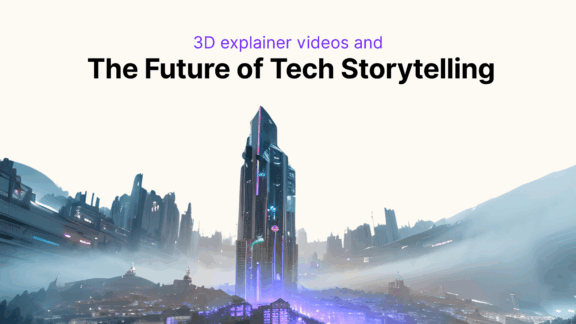
3D explainer videos and the Future of Tech Storytelling
October 21, 2025
Quick Answer: 3D explainer videos are becoming the go-to storytelling medium for emerging tech because they combine visual clarity, immersion, and brand differentiation. For founders, SaaS marketers, and innovators, using 3D storytelling isn’t just eye candy; it’s a strategic advantage for pitching, educating, and scaling in an increasingly visual-first world of AR/VR, AI, and the metaverse.
- The Rise of 3D Explainer Videos in Tech Marketing
- Why Emerging Tech Needs a New Visual Language
- From Demo to Dream: How 3D Videos Make the Invisible Visible
- A Competitive Edge: Winning Investors and Users with Immersive Storytelling
- The Science of Attention: Why 3D Content?
- The Anatomy of a Great 3D Explainer Video
- Measuring Success: How to Track 3D Explainer Performance
- FAQs
In the race to explain tomorrow’s tech brands need more than slide decks or flat animations. 3D explainer videos unlock spatial storytelling, letting viewers see inside systems, zoom into data flows, and emotionally connect with abstract ideas.
In this post, you’ll learn why 3D explainer videos are not just a “nice to have,” but a competitive edge for startups, SaaS companies, and innovators who need to communicate complexity, win funding, and stand out on a global stage.
The Rise of 3D Explainer Videos in Tech Marketing
Visual storytelling has been the backbone of tech marketing for years (think slides, product screenshots, motion graphics, and more). But as products get more complex, flat visuals struggle to convey depth, movement, or system behavior. Enter 3D explainer videos: a medium that is gaining momentum among forward-thinking tech brands.
- Demand for video content continues to surge.
- 3D is no longer the domain of blockbuster movies or gaming; it’s becoming accessible even for startups and mid-size firms thanks to more powerful tools and pipelines.
- Because 3D allows you to represent internal systems, modular parts, processes, and virtual worlds, it’s especially suited to SaaS, AI, Web3, IoT, and AR/VR applications.
In short: the era of telling is giving way to the era of showing, and 3D is the visual frontier for tech storytelling.
Why Emerging Tech Needs a New Visual Language
When your product is a neural network, a crypto consensus algorithm, or a spatial-computing SDK, words and flat icons only go so far. Emerging tech often involves:
- Invisible processes (data flows, algorithm decision-making)
- Multiple scales (macro system + micro interactions)
- Contextual interactions (how modules talk, change state)
A new visual language is needed, one that lets you translate the invisible into intuitive narrative. 3D explainer videos provide exactly that:
- You can visualize inner mechanics (e.g. how data flows through modules).
- You can shift perspective seamlessly (zoom out to show architecture; zoom in to show details).
- You can embed storytelling cues (camera movement, lighting, spatial transitions) to guide understanding rather than overwhelm.
Unlike generic 2D infographics, 3D explainer videos becomes the storytelling backbone for complex systems. It’s not just “fancy visuals”; it’s a translation layer between your innovation and your audience’s mind.
From Demo to Dream: How 3D Videos Make the Invisible Visible
One of the most powerful aspects of 3D explainers is their ability to turn conceptual demos into cinematic experiences. Rather than showing a static screenshot or icon, you can animate how your system activates, evolves, and interacts.
Use-case examples:
- Data pipelines: show packets traversing from node to node, visualizing latency, routing, failover.
- AI decision-making: represent weight adjustments, decision branches, feedback loops.
- Hardware + software integration: show how a device’s internals (circuit board, sensors) talk to software modules.
- VR/AR platform layers: show how spatial mapping, tracking, and rendering work together behind the scenes.
In 3D, you can start from a user-level shot, fly into system internals, and then return to macro context. That journey helps audiences understand how something works, not just what it does.
By visually narrating your innovation, you transform it from a technical black box to a story the viewer can follow, trust, and share.
A Competitive Edge: Winning Investors and Users with Immersive Storytelling
In startup pitch rooms and investor decks, clarity is king. When you can present your innovation not with jargon but with immersive 3D storytelling, you gain multiple advantages:
- Faster comprehension: Investors can see the working logic rather than reading bullet points.
- Memorability: A well-directed 3D sequence is more likely to stick than a slide or graph.
- Perceived professionalism: High production quality signals seriousness, technical maturity, and vision.
- Conversion-ready content: That same 3D asset can be repurposed on your website, at conferences, or in user onboarding.
One case study describes how a mid-tier tech company used a custom 3D explainer video to simplify their product’s value, leading to greater engagement and a stronger funnel.
Using 3D storytelling gives you a visual narrative weapon in a sea of slides and bullet points.
The Science of Attention: Why 3D Content?
It’s not just storytelling flair, there’s cognitive and perceptual science behind why 3D works better:
- The human brain is wired for depth cues, motion parallax, and spatial understanding: 3D exploits those cues to make content more intuitive.
- Viewers retain ~95% of a message when delivered via video, versus ~10% via text.
- Videos, especially animated ones, are repeatedly shown to increase click-through rates, dwell time, and conversion.
- 3D adds an extra dimension of visual novelty, which captures attention in saturated content spaces.
- Well-paced camera moves, transitions, and framing help guide viewer focus and reduce cognitive overload.
In other words: 3D storytelling meets the brain where it already loves to process, making complex messages easier to digest, internalize, and act upon.
The Anatomy of a Great 3D Explainer Video
To execute 3D storytelling successfully, you need more than pretty models. Here’s a blueprint for high-impact 3D explainer videos:
| Component | Role / Best Practice |
|---|---|
| Script & narrative | Start with a story arc: From context to problem to solution and impact. Avoid jargon overload. |
| Storyboarding / animatics | Visual planning ensures pacing, camera flows, and clarity before heavy rendering begins. |
| 3D modeling & environment | Realism, scale, and design consistency matter — avoid over-detail that distracts. |
| Textures, lighting & materials | These elevate perceived quality; realistic lighting gives credibility. |
| Animation & camera work | Use expressive camera moves, cut flow, and transitions to show system logic tactically. |
| Voiceover & sound design | A warm, clear narration paired with ambient audio grounds the visual experience. |
| Pacing & editing | Keep it tight—complex ideas benefit from economy and visual reinforcement. |
| Call-to-action & conversion cue | End with a clear next step (demo, download, talk) and integrate video into the funnel. |
| Optimization & export | Use progressive rendering, adaptive playback, and formats that suit both web and spatial platforms. |
Digital Brew’s approach weaves narrative, visual logic, and rendering optimization to deliver polished 3D explainers efficiently.
Measuring Success: How to Track 3D Explainer Performance
To prove value and iterate, you’ll want to monitor key metrics:
- Play rate / view-through
Percentage of visitors who click play and finish (or reach 75%). - Engagement heatmaps
Where do viewers pause, rewatch, drop off? - Click-through / conversion (CTRs)
How many viewers follow your CTA (demo signup, contact, trial)? - Time on page / dwell time
Embedding 3D explainer video should raise session duration. - A/B lift
Compare funnel conversion with/without video to quantify impact. - Qualitative feedback
Ask users or investors whether the video improved clarity or trust.
These KPIs help you iterate on narrative, pacing, and visual choices.
Why Partner With Digital Brew for Your 3D Explainer Videos
At Digital Brew, we’ve spent over a decade helping visionary tech brands bring their ideas to life through award-winning storytelling and animation.
Our Emmy-winning team blends cinematic craft with technical fluency, translating even the most complex innovations (AI, SaaS, AR/VR, Web3) into visuals that inform, inspire, and convert. We don’t just make 3D videos; we create narrative engines that clarify your technology and amplify your brand.
Whether you’re launching a product, pitching investors, or preparing for the global stage, our 3D explainers help your audience see your story, and believe in your vision.
Let’s Brew This!
FAQs
In most cases, 60–120 seconds is ideal. Enough time to explain without overload. Too long risks losing engagement.
ot necessarily. Stylized or semi-realistic visuals often perform better, they balance clarity and brand tone without overtaxing budgets.
Absolutely. Even if your product is pure software or API, 3D can visualize architecture, data flow, and abstract logic in compelling ways.
Revisit every 18–24 months (or when product pivots heavily). Meanwhile, reuse assets and update modules rather than redo from scratch.
Use them in landing pages, pitch decks, social snippets, trade shows, onboarding flows, and even immersive activations. The more distribution, the better.