The Drip Ep. 19: AI Video Production: Hype vs. Reality
August 17, 2026
Quick Answer: AI is genuinely useful in video production right now, but not the way the headlines promise. There is no single platform that takes a prompt and returns a finished, on brand video. What works is stacking specialized tools across production stages, then relying on experienced editors to guide, correct, and polish the output.
So AI just fired the entire creative department. Great. Who is buying lunch?
That is roughly the vibe of every AI video headline right now. Full movies overnight. Scripts in seconds. Zero human input. Then you actually watch one, and about five seconds in a character grows a sixth finger, physics stops applying, and any emotional thread quietly evaporates.
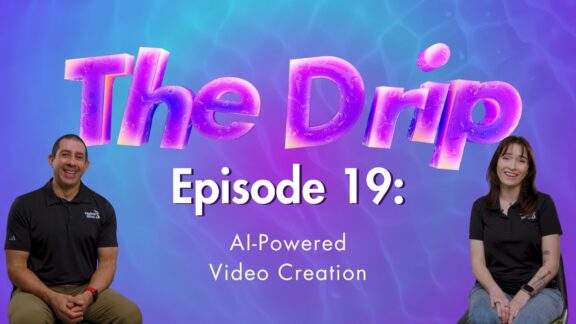
In Episode 19 of The Drip, Marketing Director Ally Nichols and VP of Business Development Nate Nazario tackle a question that confuses a lot of brands: if AI can generate video, why do you still need humans to make video that actually works?
What AI Video Production Really Looks Like Today
We tested this in house instead of guessing from a demo reel. One of our senior editors, Brant, built a 52 second character animated commercial using nothing but a stack of AI tools. The biggest lesson was not about quality. It was about workflow.
There is no magical do it all platform. Building with AI right now is closer to a chef reaching for a different knife at every step. Think Ratatouille, not a vending machine.
– Character design: some tools handle stylized faces and a consistent look far better than others
– Scene composition: different tools win on spacing, perspective, and busy multi element environments
– Animation: smoother movement, especially between keyframes, often means switching platforms again
– Finishing: upscaling, cleanup, and detail refinement are what push the result from interesting to professional
Notice what happened there. AI did not remove a job. It created one. Someone has to know which tool fits which stage, then stitch every piece into something coherent.
The Consistency Problem Nobody Puts in the Demo Reel
The clearest limitation of AI video today is consistency. Keeping a character the same across scenes, same face, same style, same eye lines, is still one of the hardest problems in the space. Even with a forgiving visual style chosen up front, our test required heavy prompting, manual cleanup, and constant editorial judgment.
That is the whole point. Anyone can prompt a clip. Far fewer people notice the angle that is slightly off, the eyeline that does not match the cut before it, or the motion that technically works but feels wrong. AI is not replacing creative professionals. It is changing what the craft consists of.
Why This Matters in Marketing
For marketers the question is not whether to use AI, it is where. These tools compress iteration cycles, expand what a small team can attempt, and make concepts cheap enough to test before you commit budget. The risk is mistaking speed for strategy. A video that renders fast but misses your brand voice or looks slightly uncanny is not a win, it is a credibility cost.
Plan for churn, too. The workflow you build today might be outdated next month, or next week. Tools update constantly, so the winning move is learning to collaborate with AI rather than betting an entire production pipeline on one platform.
Want More Marketing Insights Like This?
If you enjoy content like The Drip (real conversations, practical insights, and fresh takes on marketing) you’ll love Marketing Blend.
Marketing Blend is our weekly newsletter where we share:
– Video marketing tips
– Industry trends
– Creative insights
– Actionable ideas you can actually use
No fluff. Just a perfectly brewed mix of marketing strategy and inspiration, delivered straight to your inbox.
At Digital Brew, we help brands use AI where it genuinely helps and keep humans where they matter, across strategy, scripting, creative direction, animation, and full production. We test these tools ourselves so your video gets the speed without the six fingered weirdness.
We hope you enjoyed this episode of The Drip. If you want to talk video strategy, brand storytelling, or how to apply this concept to your own videos, you know where to find us.
Let’s Brew This!
—
What is AI video production?
It is the use of generative tools to create or assist parts of a video, such as character design, scene composition, animation, and finishing work. In practice it means combining several specialized tools rather than relying on one platform.
Can AI make a finished brand video without human input?
Not reliably. AI can produce impressive short clips, but consistency, emotional nuance, and brand alignment still break down without human direction, editing, and cleanup.
Why does consistency matter in video marketing?
Because viewers notice. Shifting faces, mismatched eye lines, or motion that feels slightly wrong undercut the polish that makes a brand look trustworthy, even when the audience cannot name what bothered them.
How can I tell if I am using AI in video the right way?
Ask three things. Did a human make the creative calls or just accept the output. Would you still publish this if it took twice as long to produce. Could you swap out any single tool tomorrow without your process collapsing. Three good answers means AI is an accelerator, not a crutch.
So AI just fired the entire creative department. Great. Who is buying lunch?
That is roughly the vibe of every AI video headline right now. Full movies overnight. Scripts in seconds. Zero human input. Then you actually watch one, and about five seconds in a character grows a sixth finger, physics stops applying, and any emotional thread quietly evaporates.
In Episode 19 of The Drip, Marketing Director Ally Nichols and VP of Business Development Nate Nazario tackle a question that confuses a lot of brands: if AI can generate video, why do you still need humans to make video that actually works?
What AI Video Production Really Looks Like Today
We tested this in house instead of guessing from a demo reel. One of our senior editors, Brant, built a 52 second character animated commercial using nothing but a stack of AI tools. The biggest lesson was not about quality. It was about workflow.
There is no magical do it all platform. Building with AI right now is closer to a chef reaching for a different knife at every step. Think Ratatouille, not a vending machine.
– Character design: some tools handle stylized faces and a consistent look far better than others
– Scene composition: different tools win on spacing, perspective, and busy multi element environments
– Animation: smoother movement, especially between keyframes, often means switching platforms again
– Finishing: upscaling, cleanup, and detail refinement are what push the result from interesting to professional
Notice what happened there. AI did not remove a job. It created one. Someone has to know which tool fits which stage, then stitch every piece into something coherent.
The Consistency Problem Nobody Puts in the Demo Reel
The clearest limitation of AI video today is consistency. Keeping a character the same across scenes, same face, same style, same eye lines, is still one of the hardest problems in the space. Even with a forgiving visual style chosen up front, our test required heavy prompting, manual cleanup, and constant editorial judgment.
That is the whole point. Anyone can prompt a clip. Far fewer people notice the angle that is slightly off, the eyeline that does not match the cut before it, or the motion that technically works but feels wrong. AI is not replacing creative professionals. It is changing what the craft consists of.
Why This Matters in Marketing
For marketers the question is not whether to use AI, it is where. These tools compress iteration cycles, expand what a small team can attempt, and make concepts cheap enough to test before you commit budget. The risk is mistaking speed for strategy. A video that renders fast but misses your brand voice or looks slightly uncanny is not a win, it is a credibility cost.
Plan for churn, too. The workflow you build today might be outdated next month, or next week. Tools update constantly, so the winning move is learning to collaborate with AI rather than betting an entire production pipeline on one platform.
Want More Marketing Insights Like This?
If you enjoy content like The Drip (real conversations, practical insights, and fresh takes on marketing) you’ll love Marketing Blend.
Marketing Blend is our weekly newsletter where we share:
– Video marketing tips
– Industry trends
– Creative insights
– Actionable ideas you can actually use
No fluff. Just a perfectly brewed mix of marketing strategy and inspiration, delivered straight to your inbox.
Subscribe to Marketing Blend
At Digital Brew, we help brands use AI where it genuinely helps and keep humans where they matter, across strategy, scripting, creative direction, animation, and full production. We test these tools ourselves so your video gets the speed without the six fingered weirdness.
We hope you enjoyed this episode of The Drip. If you want to talk video strategy, brand storytelling, or how to apply this concept to your own videos, you know where to find us.
Let’s Brew This!
—
FAQ: AI Video Production
What is AI video production?
It is the use of generative tools to create or assist parts of a video, such as character design, scene composition, animation, and finishing work. In practice it means combining several specialized tools rather than relying on one platform.
Can AI make a finished brand video without human input?
Not reliably. AI can produce impressive short clips, but consistency, emotional nuance, and brand alignment still break down without human direction, editing, and cleanup.
Why does consistency matter in video marketing?
Because viewers notice. Shifting faces, mismatched eye lines, or motion that feels slightly wrong undercut the polish that makes a brand look trustworthy, even when the audience cannot name what bothered them.
How can I tell if I am using AI in video the right way?
Ask three things. Did a human make the creative calls or just accept the output. Would you still publish this if it took twice as long to produce. Could you swap out any single tool tomorrow without your process collapsing. Three good answers means AI is an accelerator, not a crutch.